
When it comes to description, less isn’t always more. Sometimes more is more. Sometimes more is not enough. But it’s true that a lot of early writers have a tendency to overdo it. Often, the fear of not getting information across outweighs the issue of swamping the reader with confusing detail. It’s not uncommon to see a large chunk of the first chapter dedicated to giving us lengthy character or world descriptions, even if that means sacrificing a ton of pace or sidetracking the plot.
The effect’s particularly noticeable if the book also tries to hook us in with action. Things go south fast when the desire to be engaging clashes with the desire to be detailed. If you’re trying to keep things tense, you can’t interrupt a high-octane fight scene with three or four paragraphs about the protagonist’s eyes and wardrobe. That’s not a description, it’s a distraction.
So I wanted to explore just how little information a reader needs to get a picture of what’s happening in the story. It involves prompting your reader’s imagination to get them to make a few assumptions about what things look like.
Try this out:
An alert sounded as the captain stepped onto the bridge.
   ‘Problem?’ he asked.
   The pilot swivelled away from the helm. ‘Something on sonar, sir. Maybe an
 animal. Looks big.’
   ‘We’ll play it safe,’ said the captain. ‘Dive down to two thousand metres, then
 go silent.’
   ‘Aye aye, sir.’
Theoretically, the first line gives you everything you need to know. We’re on some kind of vessel, something’s happening, and here’s the person in charge. I’m relying on the word captain to make bridge call up the ‘ship’s bridge’ definition instead of the ‘planks across a river’ definition. The interaction between the captain and the pilot then tries to conjure up the submarine with terms like helm and sonar and dive.
Everything else is the reader. I don’t say the walls are grey metal, but perhaps that’s what you see. You might’ve put the captain in uniform – maybe with a hat – but that’s just me relying on the image people associate with the word captain. I use the word in the hope that you draw the character. We’re playing reverse Pictionary, essentially.
Let’s do another:
An alert sounded as the captain stepped onto the bridge.
   ‘Problem?’ he asked.
   The pilot swivelled around from her console. ‘Long range scans have picked
 up activity at the jump gate, sir. Possible hostiles.’
   ‘We’ve got to get through that gate,’ said the captain. ‘Power up shields and
 get ready to hit the afterburners.’
   ‘Aye aye, sir.’
Take a look at the third line. Swivelled implies the pilot’s got a fancy rotating chair (I guess she had one on the sub, too). Console suggests buttons and blinking lights. Again, I’m relying on the conversation to tell you what this thing actually is. The dialogue’s functional – it’s presenting a problem and advancing the story – but it’s also a conversation you couldn’t have on anything other than a spaceship.
Lastly:
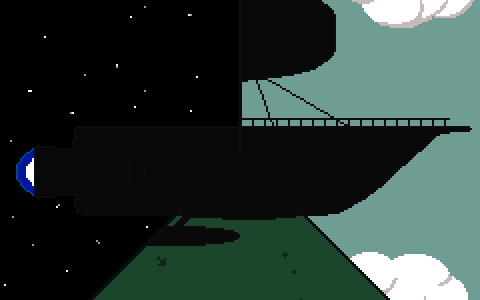
A warning bell sounded as the captain stepped onto the deck.
   'Problem?’ he asked.
   The pilot kept her hands on the wheel. ‘Balloon’s punctured, sir. We’re
 leaking hydrogen.’
   ‘Get us below the cloudline and launch a flare,’ said the captain. ‘There’s got
 to be someone out here.’
   ‘Aye aye, sir.’
So it’s some kind of steampunk airship thing, I guess. This one also tells you that the captain is a moron, since he’s about to light a flare next to a hydrogen leak.
In all of these examples, it’s not crucial for the reader to have a complete picture of the vessel right away. The submarine one, in particular, could easily be taking place on an ordinary ship until the dive line. Some readers might not have the full picture even by then. But what they do have is a stage for the action. Readers know what a spaceship looks like. Your spaceship is going to be different, perhaps, but the details can come later.
Also notice that it’s the action which builds the environment. The captain steps onto the bridge, the pilot swivels away from the controls. The pace keeps moving because the characters construct their environment by interacting with it and discussing it. This means that the features of the submarine (or whatever) only come into view as they become relevant. We don’t need to find out the airship has an anchor until the characters have a reason to drop it.
Go over some of your own descriptions. See how much of them you can cut before you actually start to lose the sense of what’s going on. It’ll help you’ll figure out what’s necessary and what’s just fluff. That’s not to say fluff is always bad, but keep it for when it’s needed.

 Melancholy Whale