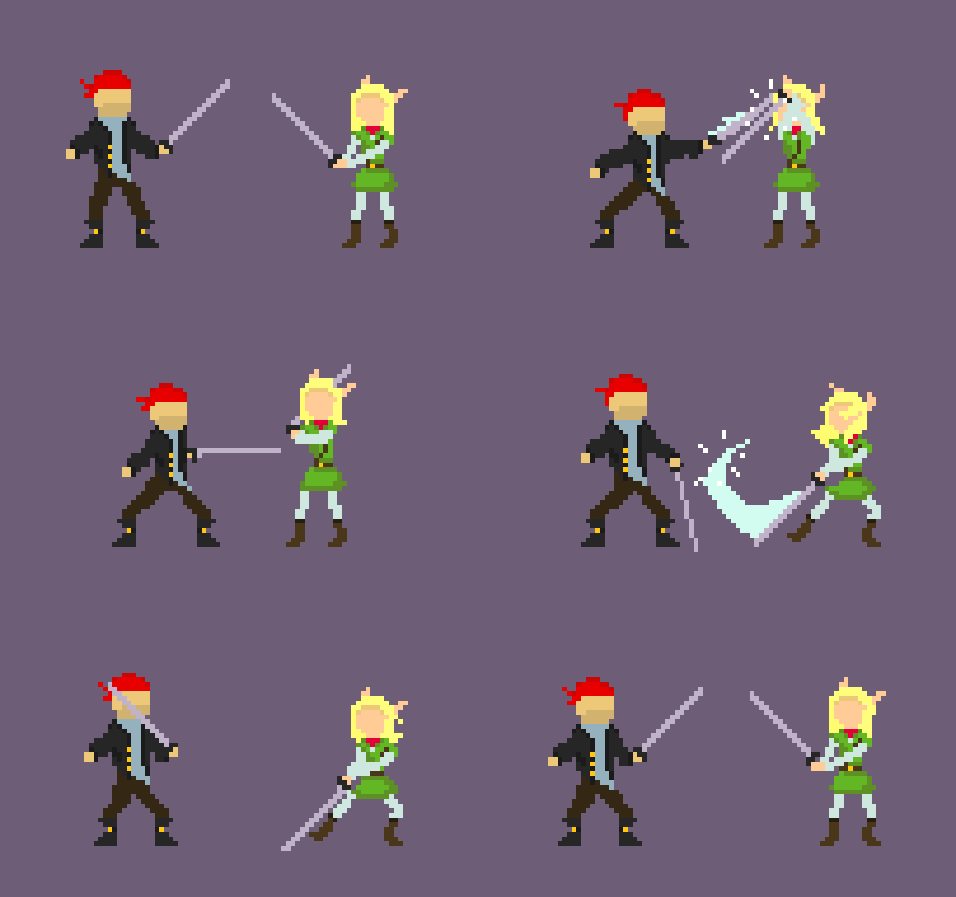
It’s a sort of tragic irony – here’s the scene with all the amazing action and explosions and people ripping each other’s necks open with Wolverine claws, and it’s just dull. It’s not that there’s nothing happening: your protagonist’s killed, like, twenty bandits so far. But it feels like nothing’s happening. And no matter how much you throw in, no matter how many of her special moves and magical powers you describe, it just seems like we’re not going anywhere.
Here are a few common problems you might be having:
You’re thinking of your fight as a single instance of conflict.
Fights have a lot of moving parts. Even if it’s just a duel between the hero and a lone enemy, it’s not simply about bashing swords together until someone falls over. The hero might attempt a particular tactic, only to find themselves outmatched by their opponent’s strength or strategy. So they revise their tactics, gain a small advantage, but then their opponent catches up, and they’re forced to revise again. Or perhaps the hero gets caught out, and sustains an injury, and now their whole approach has to change.
If it sounds like I’m describing a series of different conflicts, it’s because I am. Because a fight, whether it’s a duel or a battle, is a small story. There’s an overarching goal – victory – but there’s also a heap of obstacles along the way, and your characters have to succeed or fail at each turn, the same way they would with any other scene in your story.
So it can help to conceive of your fight not as one big scene, but as a series of smaller scenes, each with their own goal, conflict and resolution. In the case of a huge, Helm’s Deep-style battle, you might actually use several distinct scenes to tell the story. And if you go and watch The Two Towers, you’ll see that this is exactly how it’s done.
Your fight doesn’t escalate.
‘What? Of course it does! She kills the first bandit, and then two more bandits attack, and once she’s beaten them, another three-’ Okay, okay. What I should’ve said is: ‘Your fight doesn’t escalate, OR it escalates in a way that’s linear and predictable.’ If you show your character taking down a bandit, then we know she can beat a bandit. And if she beat the bandit handily (and she did, because she’s a super-cool mage-warrior-elf-elemental, and he’s a bandit) then two more bandits aren’t going to have us fearing for her life.
In an escalating fight scene, every new development should throw the hero’s victory into question. So if our elf-elemental just barely manages to dispatch the first bandit, then turns around to see another fifteen of them bearing down on her, we know she’s really got to step up her game if she’s going to pull through. Increase threats exponentially – every time your characters get ahead, hit them with something bigger and badder than whatever they’ve just faced. Switch it up, too. Make sure whatever tactics and techniques worked against the first threat are going to be ineffective against the next.
You focus too much on combat.
But it’s a fight scene. A fight scene. Fight. Fighting. Combat.
I know. The reality is, though, once you’ve seen one bandit get their head split open with a zweihander, you’ve seen them all. So it helps to break up all the sword-clashing and head-splitting with something else, particularly if you’re looking at a prolonged battle scene. Go back to Helm’s Deep again and take note of how the heroes’ objective is rarely just ‘kill more orcs’. Instead it’s things like ‘stop the orcs getting onto the wall’ or ‘give the others time to barricade this door’. Combat’s part of the solution, but usually not the whole solution, and this helps the scene feel dynamic.
It’s also possible to develop the story mid-fight. Combat’s a high-pressure situation, and high-pressure situations are good places to give your characters tough choices. Maybe Ellie the elf-elemental is crossguard-to-crossguard with Lord Peril when he informs her (with a wolfish smile) that her lover, Hunkchump Chinjaw, is being held in a launch facility not twelve kilometres from here – strapped to a space torpedo. Now the tension ratchets up. Ellie can’t just win anymore; she’s got to win now. And maybe it gets down to the wire, and she has to make a call: let Lord Peril escape, or sacrifice her one true love? The drama.
There’s no chance the heroes will lose.
Or it doesn’t matter if they do. This is tied to escalation – if the threats don’t feel significant, neither will the fight – but it’s usually a symptom of something else that’s gone wrong with your book. Perhaps you haven’t established what the stakes are, or why it would be bad if the heroes should fail. Perhaps your characters are underdeveloped, so we don’t really care about whether they get killed by bandits right now. They could also be overdeveloped, boasting so many powers and martial skills that the bandits obviously never had a chance in the first place.
But there’s a slightly trickier reason this can come up: you’ve tried to bluff us. You’ve been ‘raising the stakes’ by killing off minor characters, or flat cutouts of the protagonist’s friends and family. But your main cast – the super-cool awesome squad – they’re untouchable. There’s not even the tiniest possibility in our minds that you’re going to let any of them die, least of all in book one. It’s hard to strike the right balance with this, but every fight should feel like the characters have a chance to lose. You don’t even have to kill anyone, you just have to let us know you could.
You’re being too descriptive.
I get it. You can see the whole scene in your head: the Prince of Space jumps into the air, magical billhook aloft, and proceeds to unleash his ultra-cool-megadeath-powercharged-doomspiral attack of infinite destiny. There’s colourful lightning. His eyes glow and he shouts a lot. Time slows to a standstill. And so does the plot, because this whole thing takes four pages to describe.
This would work in a movie. It would work in a movie because, in a movie, all those details go from screen to brain in a matter of seconds. You’ve got a book, which means the more detail you put in, the more you’ll slow the scene down. Often it’s more effective to create the feel of the fight, rather than painstakingly describing every aspect of it. Verbs help: characters swing and dodge and twist and strike – stuff we can picture pretty easily without the need for much added description. Small details are louder than sweeping overviews, especially if we’re in deep POV. The sound the arrow makes as it swicks past you, the jarring in your bones as you block a downward swing. Remember that this is an actual fight, not a set of choreography notes. And fighting is fast and chaotic, so your writing can be, too.

 Melancholy Whale